Construction Site Washroom Requirements in BC: How Many Toilets, When You Need Flush, and What WorkSafeBC Actually Checks
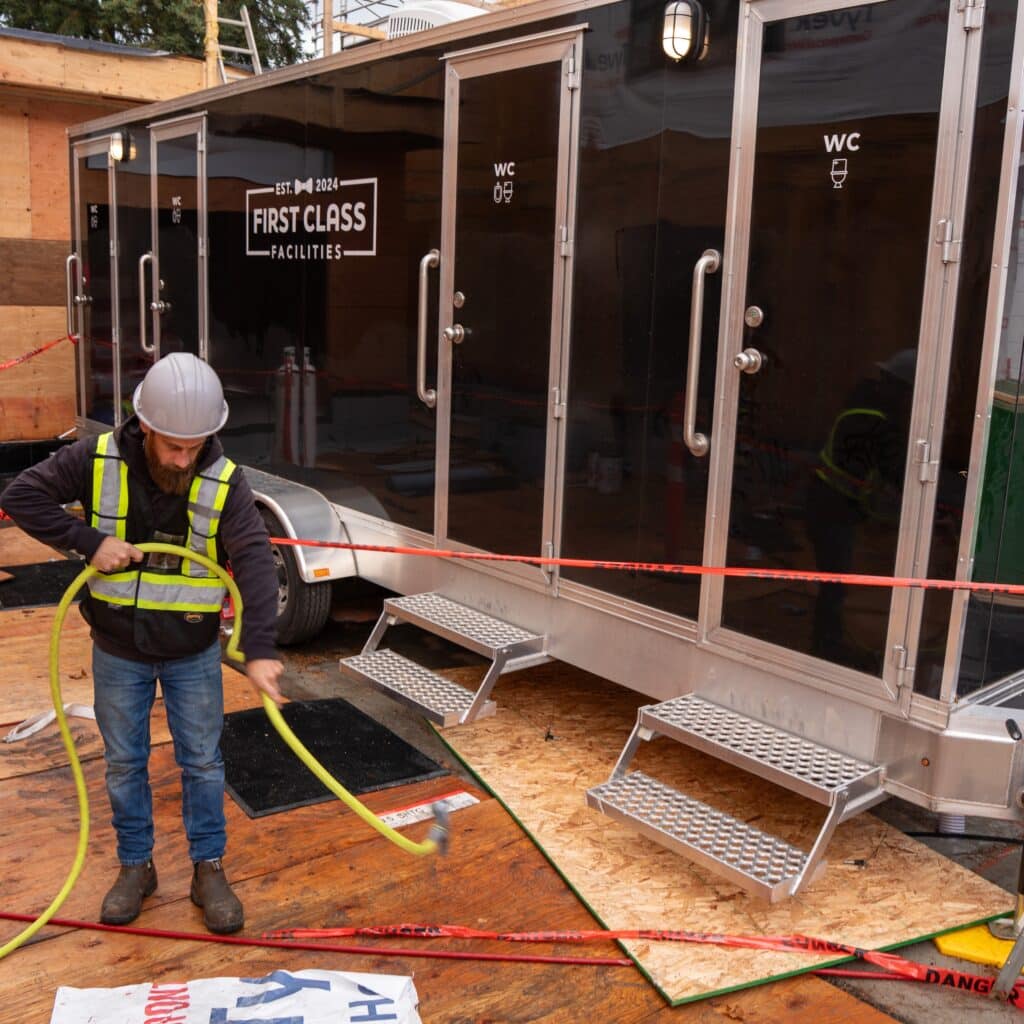
Short answer: In British Columbia, a construction site with 25 or more workers present at any time must provide flush toilets — not just portable chemical toilets. Below 25 workers, the minimum is one toilet for 9 or fewer workers, two toilets for 10 to 24 workers, and one additional toilet for every additional 25 workers after that. Facilities must be separated by gender above 9 workers, have handwashing nearby, and be cleaned as often as needed to stay sanitary — with maintenance records kept for the previous 30 days.
The rules changed on October 1, 2024, and a lot of sites on Vancouver Island still aren’t set up correctly. This guide covers what WorkSafeBC actually requires, how many toilets or washroom trailer stalls you need for any crew size from 1 to 500 workers, how often units have to be serviced, and where the legal minimum falls short of what a busy site actually needs.
The 25-worker rule: construction site washroom requirements
This is the change that catches most contractors.
Under sections 20.3.1 and 20.3.2 of the Occupational Health and Safety Regulation, a site where 25 or more workers will be present at any time is a “specified construction site.” At a specified construction site, the employer must ensure a sufficient number of flush toilets are readily available to workers.
In regards to construction site washroom requirements, A flush toilet is defined as one connected to a sanitary sewer system or a holding tank, where waste is moved by water. That second half matters: a washroom trailer with onboard holding tanks meets the definition. You don’t need to be tied into municipal sewer.
In practice a washroom trailer can be set up three ways, depending on what the site already has:
- Connected directly to sewer — where a service connection is available, the trailer discharges straight to it and never needs pumping.
- Connected to site water and power — the simplest setup on a serviced site.
- Fully self-contained — the supplier provides water and power, and waste goes to onboard holding tanks serviced on a schedule. No site services required at all.
That third option is why the “not practicable” exemption applies to fewer sites than most contractors assume. A trailer needs a reasonably level pad and vehicle access — not a hookup.
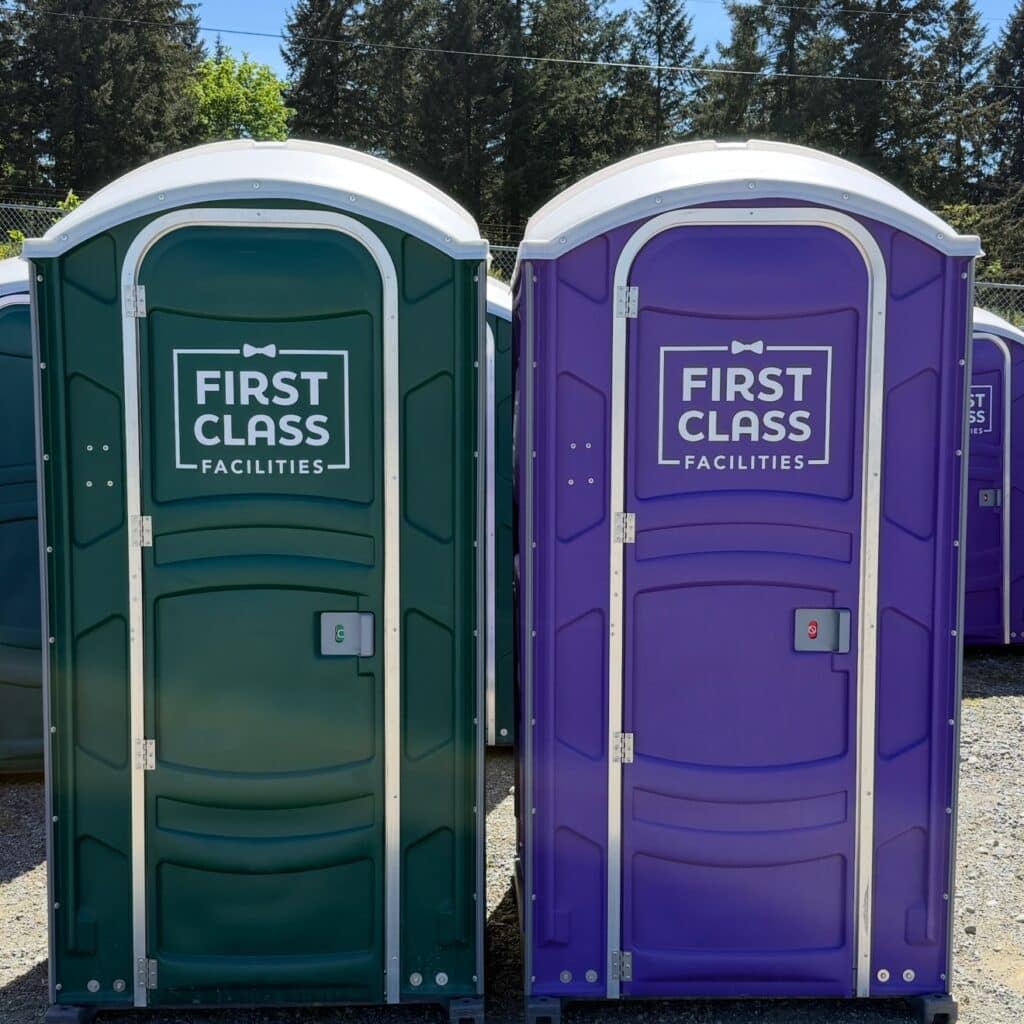
Chemical toilets — standard portable toilets — are only permitted at a specified construction site where providing flush toilets is not practicable. That’s a real exemption, not a loophole: genuinely remote sites, sites with no vehicle access, and early-stage sites with no level ground can qualify. But “we didn’t want to pay for a trailer” is not impracticability, and the burden of justifying it sits with the employer or prime contractor.
The threshold is headcount, not average headcount
The regulation says 25 or more workers present at any time. A site that normally runs 18 people but has 30 on site during a concrete pour has crossed the threshold. Plan for your peak at any given time, not your average.
How many toilets per worker? The WorkSafeBC ratio
Section 4.85 of the OHS Regulation requires sanitary toilet facilities “in sufficient numbers for the workers employed.” WorkSafeBC’s guideline sets out what sufficient means:
- 1 toilet for 9 or fewer workers
- 2 toilets for 10 to 24 workers
- 1 additional toilet for each additional 25 workers
Where more than 9 workers are present, separate facilities must be provided and clearly signed for male and female workers, and the count above applies within each washroom based on the workers using it.
Toilets and washroom trailer stalls required: 1 to 500 workers
The table below applies the WorkSafeBC ratio to total site headcount, then shows a practical setup using both washroom trailer stalls and portable toilets. Use it as your planning baseline and cross check with your WorkSafeBC representative to ensure your site is following up to date requirements.
Read it in two halves. Columns two and three are what the law requires. Columns four, five and six are how sites actually get set up — trailer stalls to satisfy the flush requirement, plus portable toilets distributed across the site to bring total capacity up to the ANSI Z4.3 industry ratio and cut walking distance.
| WORKERS ON SITE | MIN. TOILETS (WCB) | FLUSH REQUIRED? | WASH-ROOM TRAILER | PORTABLE TOILETS TO ADD | TOTAL UNITS ON SITE |
|---|---|---|---|---|---|
| 1–9 | 1 | No | Optional | 1 | 1 |
| 10–24 | 2 | No | Optional — 1 × 2-stall | 2–3 | 3 |
| 25–49 | 3 | Yes | 1 × 3-stall | 2 | 5 |
| 50–74 | 4 | Yes | 1 × 4-stall | 4 | 8 |
| 75–99 | 5 | Yes | 1 × 3-stall + 1 × 2-stall | 5 | 10 |
| 100–124 | 6 | Yes | 1 × 4-stall + 1 × 2-stall | 7 | 13 |
| 125–149 | 7 | Yes | 1 × 4-stall + 1 × 3-stall | 8 | 15 |
| 150–174 | 8 | Yes | 2 × 4-stall | 10 | 18 |
| 175–199 | 9 | Yes | 2 × 4-stall + 1 × 2-stall | 11 | 20 |
| 200–224 | 10 | Yes | 2 × 4-stall + 1 × 2-stall | 13 | 23 |
| 225–249 | 11 | Yes | 2 × 4-stall + 1 × 3-stall | 14 | 25 |
| 250–274 | 12 | Yes | 3 × 4-stall | 16 | 28 |
| 275–299 | 13 | Yes | 3 × 4-stall + 1 × 2-stall | 17 | 30 |
| 300–324 | 14 | Yes | 3 × 4-stall + 1 × 2-stall | 19 | 33 |
| 325–349 | 15 | Yes | 3 × 4-stall + 1 × 3-stall | 20 | 35 |
| 350–374 | 16 | Yes | 4 × 4-stall | 22 | 38 |
| 375–399 | 17 | Yes | 4 × 4-stall + 1 × 2-stall | 23 | 40 |
| 400–424 | 18 | Yes | 4 × 4-stall + 1 × 2-stall | 25 | 43 |
| 425–449 | 19 | Yes | 4 × 4-stall + 1 × 3-stall | 26 | 45 |
| 450–474 | 20 | Yes | 5 × 4-stall | 28 | 48 |
| 475–499 | 21 | Yes | 5 × 4-stall + 1 × 2-stall | 29 | 50 |
| 500 | 22 | Yes | 5 × 4-stall + 1 × 2-stall | 28 | 50 |
The portable toilet column isn’t padding. On a large or vertical site, a single trailer at the gate means a crew on the far corner or the fifth floor loses ten minutes a trip. Distributed portable units solve travel distance; the trailer satisfies the flush requirement and gives everyone somewhere with running water, heat and a door that locks.
Wheelchair-accessible portable units are available and should be included wherever a site has accessibility requirements — they are not counted separately in the table above.
Important: gender separation can raise your total
Because the ratio applies within each gender-separated washroom, an uneven split increases the count. On a 100-worker site split 80 men and 20 women, the men’s facilities need 5 toilets and the women’s need 2 — 7 total, not the 6 shown in the table.
Treat the table as a floor. Size from your actual crew composition, and round up.
How often do construction site toilets need to be serviced?
For construction site washroom requirements, the regulation does not set a fixed interval. Section 20.3.2 requires that each toilet be maintained in proper working order and cleaned and sanitized as frequently as necessary to keep it in a clean and sanitary condition.
“As frequently as necessary” is judged by the result, not the schedule. In practice:
| SITE CONDITIONS | TYPICAL SERVICE FREQUENCY |
|---|---|
| Up to 10 workers per unit, standard 40-hour week | Weekly |
| More than 10 workers per unit, or extended shifts | Twice weekly |
| High-traffic sites, summer heat, or 7-day operations | Two to three times weekly |
| Washroom trailers with holding tanks | Based on tank capacity and headcount — often twice weekly or more |
ANSI Z4.3 treats weekly service as the minimum for a unit serving up to 10 workers on a 40-hour week. Above that ratio, or on sites running longer days, weekly service will not hold the standard the regulation requires.
The 30-day records rule
Section 20.3.2 requires that maintenance records covering the previous 30 days be retained. This is the part most sites miss until an officer asks.
If your supplier can’t produce a dated record of every service visit, you have a documentation gap on your site — regardless of whether the units were actually clean. Ask any prospective supplier what their service record looks like before you sign.
At Fist Class Facilities, each of our technicians completes a report with proof of service after each service and is available anytime upon request.
Handwashing requirements
A handwashing facility must be located within or close to the enclosed washroom space. Under section 20.3.1, a handwashing facility means workers can wash with soap and water, or clean their hands by some other means where providing water is not practicable.
Under section 4.85, where plumbed washrooms are in use, the standard is one wash basin with hot and cold running water for each washroom containing one or two toilets or urinals, plus one additional basin for each additional two fixtures.
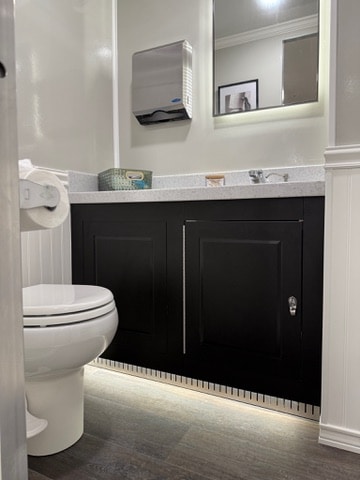
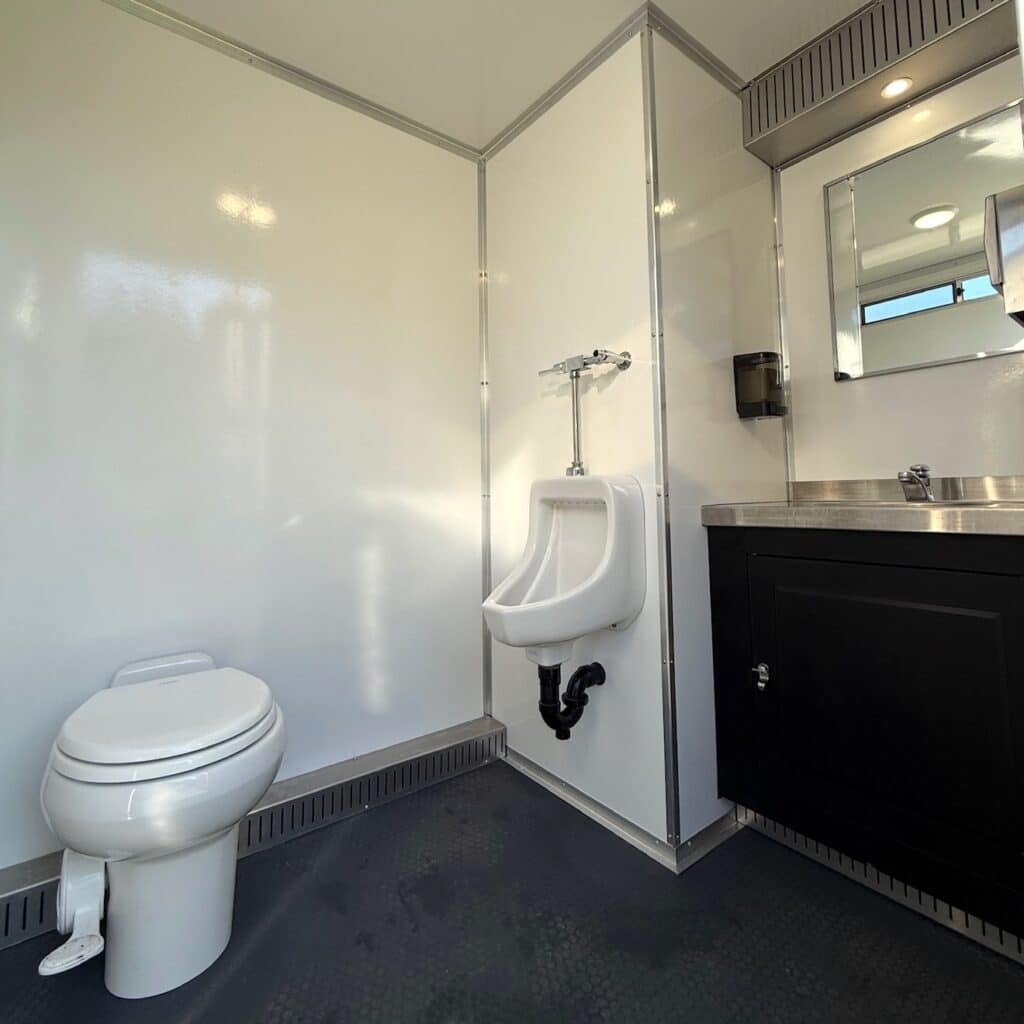
Washroom trailers include sinks with running water as standard. If you’re running portable toilets, hand-wash-equipped units or standalone hand-wash stations cover this requirement.
What else the facility itself has to provide
Under section 20.3.2, each toilet must be located in an enclosed space that provides:
- Privacy
- Lighting
- Ventilation
- Heating, where practicable
- A handwashing facility within or close by
- Supplies necessary for use — toilet paper, soap, hand drying
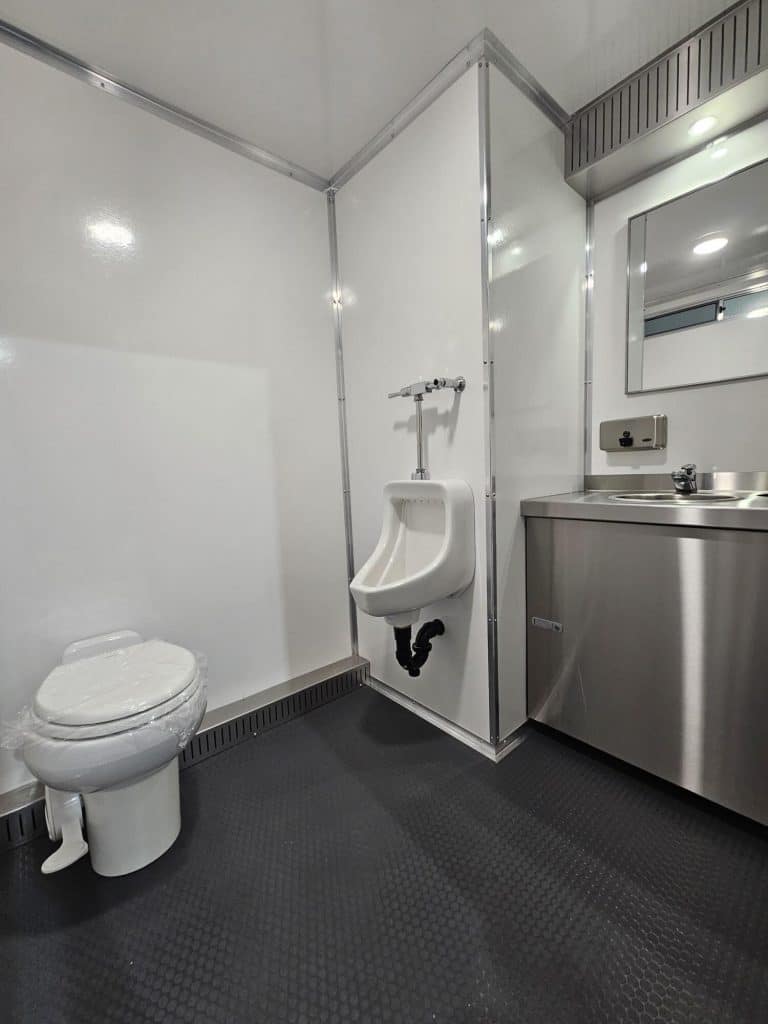
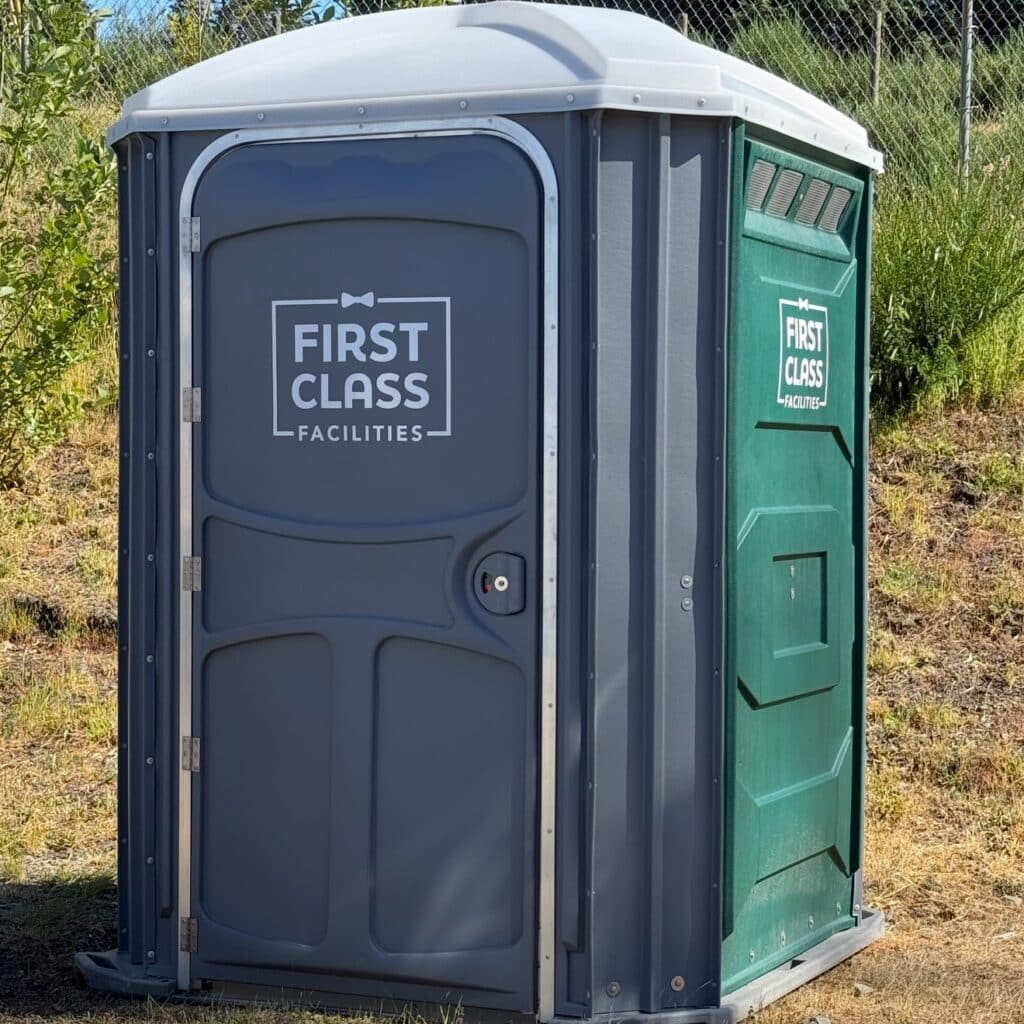
Lighting and heating are the two most commonly overlooked on Vancouver Island sites running through winter, and they’re the two a standard chemical toilet cannot provide.
This is a real gap on Island jobs. A site running November through March on Vancouver Island are asking workers to use an unlit, unheated plastic box in the rain — and the regulation asks for lighting and, where practicable, heat. Our worksite trailers are heated and air conditioned, with interior lighting and ventilation as standard, which covers the requirement year round rather than seasonally.
Feminine hygiene products
The regulation requires washrooms be provided with “the supplies necessary for their use.” On sites with women working, that reasonably includes period products — and almost no construction site in British Columbia stocks them.
First Class Facilities partners with Joni, a Canadian company, to stock tampons and pads in every washroom trailer and in select portable toilets. As far as we know, we’re the first company in Canada to put period care into portable toilets as standard rather than on request.
It costs a contractor nothing extra and it removes a genuine barrier for women on site — one that gets talked about at exit interviews far more than it gets talked about at pre-job meetings.
Who is responsible — the employer or the prime contractor?
Both. The employer must ensure toilets are readily available to their workers. On a multiple-employer worksite, the prime contractor shares those obligations under section 20.3.2.
In practice this means a subtrade cannot assume the GC has it handled, and a GC cannot point at a subtrade. If facilities are inadequate, both can be cited. Sorting out who is supplying and servicing washrooms belongs in the pre-job meeting, not the first week of work.
Remote sites and when flush toilets aren’t practicable
WorkSafeBC recognises that some sites genuinely cannot support a flush facility. Where providing flush toilets is not practicable, chemical toilets or another alternative may be used at a specified construction site.
Factors that support an impracticability assessment include no road access for a trailer, no level ground for placement, a site too small to accommodate a unit, or a work front that relocates constantly. It is a site-specific judgment, and it should be documented alongside your other site planning — not assumed.
Worth knowing before you conclude a site is exempt: modern washroom trailers with onboard fresh water and holding tanks need no hookups at all, only a reasonably level pad and vehicle access for delivery and servicing. On Vancouver Island we regularly place trailers on remote sites from Port Renfrew to the Cowichan Lake logging roads.
Frequently asked questions
How many toilets are required for 25 workers in BC?
Three toilets, and at 25 workers the site becomes a “specified construction site” — meaning flush toilets are required rather than chemical toilets, unless providing them is not practicable. Facilities must also be separated by gender.
Do I need a washroom trailer or will portable toilets do?
Below 25 workers, portable toilets meet the requirement. At 25 or more workers present at any time, you need flush toilets — which on a site without sewer access means a washroom trailer with holding tanks. Chemical toilets are only permitted where flush toilets are not practicable.
How many porta potties do I need for 50 workers?
WorkSafeBC’s minimum for 50 workers is four toilets, but at 50 workers flush toilets are required, so a 4-stall washroom trailer is the compliant setup. The ANSI Z4.3 industry standard would suggest capacity for eight — commonly met with a trailer plus distributed portable toilets.
How often do portapotties need to be cleaned on a job site?
WorkSafeBC requires cleaning and sanitizing “as frequently as necessary” to keep units clean and sanitary, rather than a fixed interval. Weekly service is the industry minimum for one unit per 10 workers on a 40-hour week; busier sites and longer shifts typically need twice-weekly service or more.
Does a construction site washroom need running water?
A handwashing facility must be within or close to the toilet enclosure. Workers must be able to wash with soap and water, or clean their hands by another means where providing water is not practicable.
When did the BC construction washroom rules change?
The amendments to the Occupational Health and Safety Regulation took effect on October 1, 2024, adding sections 20.3.1 and 20.3.2 and introducing the flush toilet requirement at sites with 25 or more workers.
Do washroom facilities have to be separated by men and women?
Yes. Where more than 9 workers are present, separate facilities clearly signed for male and female workers are required. The toilet count applies within each washroom, which can raise your total above a straight headcount calculation.
How long do I need to keep washroom maintenance records?
Records of maintenance covering the previous 30 days must be retained and available.
Do construction washroom trailers need water and power hookups?
No. A trailer can be connected directly to site water and power, or connected straight to a sanitary sewer where a service exists, or run fully self-contained with supplied water, power and onboard holding tanks. A self-contained trailer needs only a reasonably level pad and vehicle access.
Are construction washroom trailers heated in winter?
WorkSafeBC requires heating where practicable. First Class Facilities worksite trailers are heated and air conditioned with interior lighting and ventilation as standard, which meets the requirement year round — something a standard chemical toilet cannot do.
Do construction sites have to provide feminine hygiene products?
The regulation requires washrooms be provided with the supplies necessary for their use. On sites with women working, period products reasonably fall within that. First Class Facilities stocks Joni tampons and pads in every washroom trailer and in select portable toilets as standard and is included in the price of your service.
Does First Class Facilities have washroom trailers and portable toilets and are they full service?
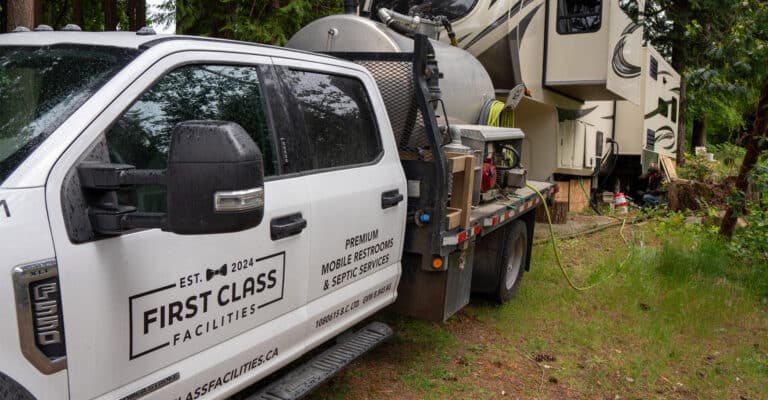
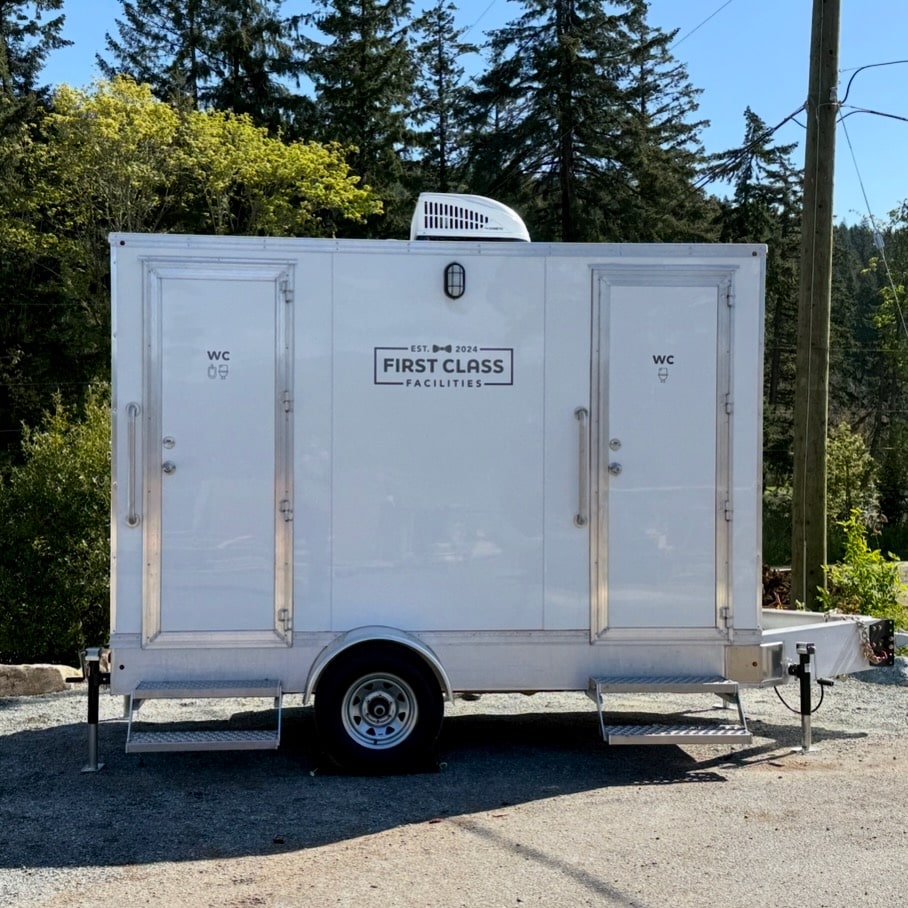
Yes, First Class Facilities offers 2, 3 and 4 stall washroom trailers in our comfort trim, made specifically for heavy duty construction sites along with our durable portapotties. We have a fleet of service trucks that can service at any interval. Serving Parksville to Victoria and everywhere in-between.
Sizing your site
If you have a worksite or are planning a site on Vancouver Island and want a straight answer on what you need, we’ll size it with you — peak headcount, crew composition, site access, and how long the job runs. No obligation, and no pressure to take more units than the site actually needs.
First Class Facilities supplies worksite washroom trailers and portable toilets from Parksville to Victoria, including Duncan, Nanaimo, Langford and Sidney. Trailers are heated and air conditioned, run self-contained or connect directly to site water, power and sewer, and come stocked with Joni period products as standard. Flat published pricing with no fuel or environmental surcharges, and a dated service record for every visit.
Checkout our pricing guide for up to date pricing! Reach out anytime for a custom quote or give us a call at 250-710-3191.
A note on accuracy: This guide is general information, not legal or regulatory advice. It reflects our reading of the Occupational Health and Safety Regulation and WorkSafeBC guidelines at the time of writing, and requirements can change or apply differently to your specific site. Before making compliance decisions, confirm the current requirements directly with WorkSafeBC or a qualified advisor. Responsibility for compliance always rests with the employer and prime contractor.